I’m pumped! Artificial intelligence is moving beyond simple prompts and one-off tasks.
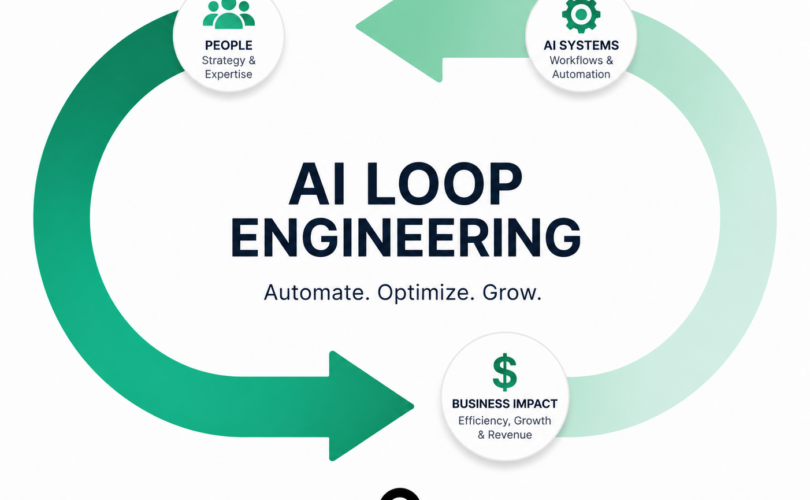
The next evolution is something called AI Loop Engineering—the process of creating AI systems that continuously execute a set of instructions, evaluate results, and take the next action without requiring constant human input.
If you’ve been hearing terms like agents, autonomous workflows, routines, or loop engineering and wondering how they apply to a real business, you’re not alone.
The good news is that you don’t need to be a software engineer to start building useful AI agents.
In this article, I’ll explain what AI loop engineering is, how it differs from traditional prompting, and share practical examples for food brands, produce companies, and CPG marketing teams.
What Is AI Loop Engineering?
Most people use AI like this:
- Ask a question
- Receive an answer
- Decide what to do next
This is a single interaction.
Loop engineering introduces a cycle:
- Define a goal
- Give AI access to information
- Allow it to perform a task
- Review the output
- Decide the next step
- Repeat until the goal is achieved
Instead of asking AI to perform a single task, you’re creating a system that continuously works toward an objective.
Think of it less like a calculator and more like an employee following a standard operating procedure.
Traditional Prompting vs. AI Loops
Traditional Prompt
Write an Instagram caption for Pineapple.
AI completes the task.
Done.
AI Loop
Goal:
Increase awareness and sales of Pineapple.
AI then:
- Reviews recent social posts
- Identifies top-performing content
- Generates new post ideas
- Creates captions
- Suggests influencer outreach opportunities
- Drafts emails
- Repeats the process weekly
The AI isn’t simply creating content.
It’s working through a process designed to achieve a business objective.
Why Marketing Teams Should Care
Most marketing departments spend enormous amounts of time on repetitive work:
- Content creation
- Campaign planning
- Social media management
- Competitive research
- Reporting
- Influencer outreach
- Retail activation planning
These activities follow predictable patterns.
Anything that follows a pattern can potentially be turned into a loop.
This doesn’t eliminate marketers.
It allows marketers to spend more time on strategy and decision-making.
Example 1: The Social Content Agent
Let’s say you’re a produce company promoting Chiles.
Instead of creating every social post manually, you create an AI content loop.
Goal
Increase engagement and awareness leading up to Hatch season.
Routine
Every Monday:
- Review top-performing Chile pepper content from the previous week
- Identify common themes
- Generate:
- 5 social post ideas
- 3 video concepts
- 2 recipe ideas
- Draft captions
- Create hashtag recommendations
- Deliver everything in a report
IMPORTANT NOTE: Once you were the loop prompt, ask for a sample output so that you can review and ensure the output will be helpful.
The marketing manager reviews and approves.
What previously took hours now takes minutes.
Example 2: Retail Sell-Through Agent
This is where things get particularly interesting for food and CPG companies.
Goal
Increase retail velocity for a product.
Imagine you’re launching:
- Snack item
- Fresh produce item
- New beverage
- etc
Your AI agent could:
Weekly Loop
- Analyze sales reports
- Identify underperforming regions
- Review social activity
- Review retailer promotions
- Compare performance by market
- Recommend actions
For example:
Velocity is declining in Southern California stores. Recommend influencer activity targeting Los Angeles and Orange County, paired with a retailer promotion.
Instead of manually reviewing dozens of spreadsheets, the AI highlights opportunities.
Example 3: Influencer Discovery Agent
Most food brands struggle with influencer outreach.
The process usually involves:
- Finding creators
- Reviewing engagement
- Evaluating content quality
- Sending outreach
This is highly repetitive.
Goal
Identify 10 new creators every week.
Loop
- Search for creators discussing:
- meal prep
- healthy eating
- produce
- grocery shopping
- Analyze audience size
- Analyze engagement
- Score fit
- Create outreach recommendations
- Draft introductory emails
The marketing team simply reviews the recommendations.
Example 4: Competitive Intelligence Agent
Most marketing teams monitor competitors inconsistently.
An AI loop can automate much of the work.
Goal
Track competitors weekly.
Routine
Every Friday:
Review:
- Social media activity
- New product launches
- Retail promotions
- Email campaigns
- Website updates
Generate:
- Summary report
- Emerging trends
- Potential threats
- Opportunities
Instead of spending several hours researching competitors, the team receives a concise briefing.
Example 5: New Product Launch Agent
Product launches involve dozens of moving pieces.
An AI loop can coordinate much of the planning process.
Goal
Support a product launch from concept through execution.
Routine
Review:
- Launch timeline
- Content calendar
- Retailer commitments
- Influencer schedules
Generate:
- Weekly action plans
- Missing deliverables
- Recommended content
- Risk alerts
The marketing team remains in control while AI manages the operational complexity.
The Three Components of Every AI Loop
Whether you’re in food, produce, retail, or CPG, every successful AI loop contains three elements.
1. Goal
What are you trying to accomplish?
Examples:
- Increase sales
- Generate leads
- Improve engagement
- Launch a product
Without a clear goal, AI creates activity instead of results.
2. Data
What information can AI access?
Examples:
- Sales reports
- Social media metrics
- Retail velocity reports
- Email performance
- Influencer databases
The better the information, the better the recommendations.
3. Routine
What process should AI follow?
Think like a manager creating a standard operating procedure.
If you can document a process, there’s a good chance AI can help execute it.
Where Most Companies Get It Wrong
The biggest mistake I see is focusing on the technology instead of the business problem.
Companies ask:
How do we use AI?
A better question is:
What repetitive process is consuming time and preventing growth?
Start there.
Then determine whether a loop can help automate, accelerate, or improve the outcome.
IMPORTANT: Increasing sales is a lagging indicator… find the leading indicators in your business and utilize AI for repeating these processes.
Getting Started With AI Loop Engineering
You don’t need a custom application or engineering team.
Start small.
Choose one recurring marketing activity such as:
- Social planning
- Influencer discovery
- Retail reporting
- Competitive analysis
Document the process.
Create the routine.
Define the goal.
Then use AI to execute the first version.
The best AI systems aren’t necessarily the most complex.
They’re the ones that consistently save time, improve decisions, and help teams focus on higher-value work.
Final Thoughts
AI loop engineering represents a shift from using AI as a tool to using AI as a teammate.
For food brands, produce companies, and CPG marketers, the opportunity isn’t simply generating more content.
It’s creating systems that continuously support business objectives while reducing manual effort.
The companies that learn to build these loops today will have a significant advantage over those still treating AI like a glorified search engine.
The question isn’t whether AI will become part of your marketing department.
The question is which processes you’ll automate first.
Interested in building AI-powered marketing systems for your business?
AI Consulting
We help local and retail businesses turn more leads into revenue using fast-response systems.